495 points by matthest about 8 hours ago | 557 comments | View on ycombinator
pclowes about 6 hours ago |
kleiba about 1 hour ago |
> From 2015 to 2024, Austin added 120,000 units to its housing stock—an increase of 30%
Compare that to the following [1]:
> The [...] government [...] intended to build 400,000 new homes annually, including at least 100,000 social housing units. This target was significantly missed from 2021 to 2024. In each year from 2021 to 2023, fewer than 300,000 new homes were built.
So, the city of Austin alone build on average 12,000 new housings each year, while all across Germany, they failed to build 300,000 new units. That's roughly a 1:25 ratio.
So, how much bigger is Germany than Austin, Texas? More than 80 times bigger.
Is that just because big projects don't scale linearly? I would think that that's definitely one factor. Also, I'm not convinced that economy of scale laws apply here, given that this is not one company building 300,000 houses.
But it does show a number of problems inherent in Germany's current situation: (a) shortage of skilled laborers; (b) high cost of labor; and (c) exorbitantly much red tape. These three points alone are among the most frequently cited factors that companies feel inhibit business, and it holds across disciplines.
[1] https://www.wsws.org/en/articles/2025/08/20/vmjm-a20.html
rconti about 7 hours ago |
riknos314 about 8 hours ago |
nemomarx about 8 hours ago |
I'm sure the analysis is welcome though and I hope policy makers try to learn from this. We could densify most american cities quite a lot more.
nomilk about 7 hours ago |
I put this question to grok; its response:
> Unfortunately, Australia's legal, regulatory, financial, and practical systems make this extremely difficult (bordering on impossible at any meaningful scale).
Crazy that the reason we can't have an order-of-magnitude reduction in the cost of the most important thing people need (shelter) is not due to resource constraints, but man-made ones.
lifeisstillgood about 7 hours ago |
All three of the five things most economists say about house building - and each one will hit house owning voters hard making it hard to replicate.
But none the less a triumph of common sense :-)
jackconsidine about 7 hours ago |
karakoram about 5 hours ago |
Everywhere you look, Australia, Canada, UK, EU this is just a massive issue for young professionals with long-term disastrous downstream political consequences, and yet, the solution is so simple but hardly ever implemented in these countries.
Just BUILD MORE HOUSING. Mass build everywhere. Vast amounts of land is available. Just build homes and apartments everywhere!
alsetmusic about 6 hours ago |
Similarly, the tested and proven solution to homelessness is providing housing up front. Don't have any requirements (employment, sobriety, etc) blocking housing. Those things are easier to achieve with a roof over your head.
exabrial about 5 hours ago |
xwowsersx about 8 hours ago |
clamprecht about 7 hours ago |
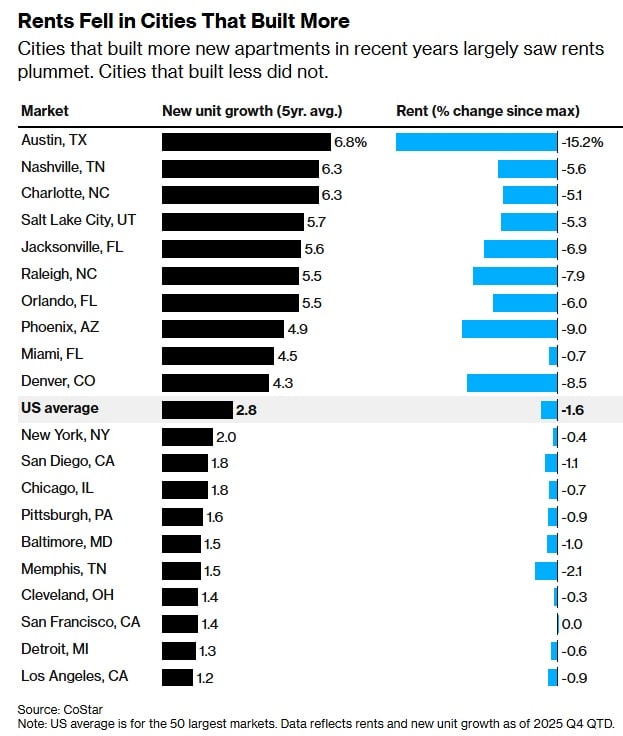
> "Rents fell. In December 2021, Austin’s median rent was $1,546, near its highest level ever and 15% higher than the U.S. median ($1,346)."
Of course having more housing should, all things equal, lower rent. But all things certainly weren't equal, especially during this time period.
legitster about 7 hours ago |
It's a win-win for our tenants. Prices seem to be stable and there's no rush for them to lock down a house RIGHT NOW.
It's sure not good for my bottom line as a landlord for them to keep adding homes and keeping rates up. But it sure seems like a no brainer for society at large.
CSMastermind about 7 hours ago |
Increased supply lowered prices for the same levels of demand?
Seems unlikely.
jeffbrines about 4 hours ago |
EcommerceFlow about 3 hours ago |
KellyCriterion about 2 hours ago |
:-)
Gigachad about 7 hours ago |
shcheklein about 7 hours ago |
kart23 about 7 hours ago |
interest rates for construction loans, reduced funding, labor and material costs, all contribute to the amount of housing built.
there is a bond being debated in the ca senate now that will help by giving loans for construction.
https://calmatters.org/politics/2026/01/2026-housing-agenda/
rgovostes about 6 hours ago |
Maybe if you flood the market with 30% more housing units like Austin you get the Econ 101 effect. On the other hand, apartment owners realized intentional vacancy is a profitable strategy, which alone seems to defy that basic interpretation.
jeffbrines about 4 hours ago |
Austin is not what people pretend. Same with Denver or SLC.
There are no tier 2 cities. Its like countries. There are first world, and third world. And thats it.
caditinpiscinam about 5 hours ago |
What this article says: *The median apartment rent in Austin has dropped X% over the past 5 years*
What this article does not say: *Apartments in Austin cost X% less to rent now than they did 5 years ago*
It's completely possible for the cost of the average apartment in a city to go down, while the cost of existing apartments increases. How does this happen? The enshittification of rentals. Units get smaller (apartments in Austin are shrinking), they get built near highways (air pollution), they lose amenities like parking, they pop up places where they previously weren't allowed (smaller ADUs, basement units, see article), they get subdivided (landlord throws up a wall and turns a large 1br into a cramped 2br).
If supply and demand were really working the way its heralds claim, then we'd see the price of existing units going down. This article offers no evidence that this is happening. I don't believe for a minute that it is.
Instead, it's the same story as always: your rents will keep going up. You can move somewhere cheaper and shittier if you want. The people who profit will congratulate themselves while decrying the thing they actually fear: rent control.
https://www.statesman.com/story/business/real-estate/2025/05...
nielsbot about 3 hours ago |
He says that building housing does bring prices down, but not very much. In his paper they argue that income inequality is a big driver of making housing unaffordable. (Not billionaires, but more those making more than the median income vs the rest) Because (among other reasons) those with higher income have leeway to spend more on housing versus those at the lower end of the income scale who can’t spend more on housing even if they get a raise.
https://www.youtube.com/live/ai76174930Q?si=R-FYO86COepRADhE...
xiaolu627 about 4 hours ago |
undefined 36 minutes ago |
babybjornborg about 6 hours ago |
myttle_web396 about 3 hours ago |
ksec about 6 hours ago |
Even adjusting for inflation, and even if the measurement of inflation is decent, it would still need to go down by another 20%.
afh1 about 7 hours ago |
lanfeust6 about 7 hours ago |
mancerayder about 6 hours ago |
As annoying as NYC (and driving) are, there are downsides to unlimited housing and lack of zoning - as it turns out, the same states that do this sort of thing we all praise, are the same laissez-faire philosophies that oppose communal public transportation and walkable urban communities.
lumirth about 7 hours ago |
Not sure the idea of housing being an asset which endlessly accrues value is good for anybody involved, long-term. Open to disagreement, though! I’m no economist.
yieldcrv about 5 hours ago |
benguild about 2 hours ago |
imadch about 7 hours ago |
Small incremental changes probably just get absorbed without visible impact on rents.
fzeroracer about 1 hour ago |
For reference, I moved to Austin in 2018, my rent for my apartment was about 1200/month. In 2022 (the year I left), my rent jumped suddenly to 1600/month despite new apartments near me, and all of the apartments I looked into had similar jumps. And anecdotally speaking my coworkers all reported similar massive rent spikes.
It feels more like this is associated with the tech industry cooling significantly in Austin so they can't get away with pricing bumps. This isn't to say new housing doesn't help, but it certainly didn't prevent me from getting fucked on rent.
redwood about 6 hours ago |
redwood about 6 hours ago |
cat-turner about 7 hours ago |
zombot about 2 hours ago |
tonymet about 7 hours ago |
plantain about 6 hours ago |
diogenescynic about 5 hours ago |
I say this with a bit of righteous anger though because the moronic democrats in California want to virtue signal about housing and homelessness but they make it downright as difficult and expensive as possible to increase housing supplies. The democrats in California have done nothing but make our problems worse, even as there are states we can look to with proven examples to solve our problems. Nope... more housing lotteries and BMR units will be required instead of just making it easier to actually build..
elng about 5 hours ago |
shablulman about 8 hours ago |
ctdinjeu2 about 7 hours ago |
cyberax about 6 hours ago |
So what did? Likely COVID. The _only_ way to decrease the housing prices is to decrease the population. As proven by countless cities, including the world's most liveable Copenhagen.
So does my prediction hold for Austin? Let's see.
Austin TX population in 2019 (ACS estimate, data series ACSDP1Y2019.DP05): 979263.
2021 (ACSDP1Y2021.DP05): 944658
2023 (ACSDP1Y2023.DP05): 979700.
2024 (ACSDP5Y2024.DP05): 979539.
So yep, my prediction holds true. The housing prices in Austin were stagnant because its population decreased during COVID and barely recovered to pre-COVID levels.
Want another prediction? Seattle's home prices will fall down, because its population is now (likely) decreasing. Not because of a rush of new construction. We'll see updated population released stats in April.
Edit: I sent a letter to the editor of Pew. We'll see if they have a shred of honesty (doubt it).
Edit 2: honest researchers take care to control for other factors before jumping to conclusions. For example, they could have found a comparable city that also had falling rents but _no_ significant new construction.
And hey, I did that. According to https://vitalsigns.mtc.ca.gov/indicators/asking-rents the rental price in SF was $4060 in 2019, and it fell to the low level $3319 in 2024 before starting to climb in 2025. Can you guess what was happening with its population?
postflopclarity about 7 hours ago |
easterncalculus about 5 hours ago |
If you want a success story, look a Vienna. That's what actual community and housing looks like and its because of the exact opposite of what econ clowns on here believe, non-market housing.
lasky about 6 hours ago |
We need affordable housing, not more housing for rich people, made by rich developers. Just because my house is worth $3M and I have $3M in stock options doesn't mean I'm rich. I'm working class, I had to come back from paternity leave to log-in to Slack on my laptop every damn day, and tell Claude how to write this damn software!
Did you sign the petition to block the apartment building down the street? It would RUIN our neighborhood!!
As an aside, I am not part of the problem!! I care about poor people!!! I am a good person!!!!
Oh you want proof? Look at my front lawn: "In this house we believe black lives matter, science is real, love is love..."
Proof point 2: look at my Tesla! "I bought this Tesla before I knew Elon was crazy!"
Plus I voted for Kamala. I'm GOOD. People in Kansas are DUMB and BAD.
bob1029 about 2 hours ago |
The quality of construction in these new builds is generally very bad. If you compare a Texas home built in 2025 with one in 2015, I can guarantee you will find shocking differences once you pull back some of the drywall or have kids jumping around upstairs. I had a 2023 build for a year before I realized I had a hot potato situation on my hands and decided to bail.
The new builds used to command a premium, but in some communities the situation has completely inverted. Buyers are coming in and explicitly avoiding anything built in the new millennium. Information is flowing so much more freely around real estate and the unspoken bullshit scams prevalent within. We've now got home inspector influencers on TikTok showing first time homebuyers exactly what to look out for. We didn't have these kinds of information channels when I was shopping for my first home.
Build more housing. Keep law and order.
No it doesn’t need to be “affordable”. Yes rent control is a terrible idea.
Just build more housing.
Note: that the US already has plenty of housing and housing costs basically go up in areas of low crime relative to economic opportunity. If you build housing, but allow crime to rise, you have wasted everybody’s time.