237 points by jandeboevrie 4 days ago | 375 comments | View on ycombinator
suby 4 days ago |
pseudalopex 4 days ago |
No ability to save and restore positions of native Wayland windows
Real-fake-session-restored apps don't remember which virtual desktop their windows were on
No full-screen aspect ratio correction
"Spare Layouts" feature not implemented
"Per-application Keyboard Layout" does not work
No way to change the gamma or manually adjust the colors without generating or finding an appropriate ICC profile
Can't switch between multiple touch strip modes
No headless RDP
Opening files using command-line binaries in Konsole doesn't raise existing windows
Global Menu is not supported for non-Qt apps
Some apps' non-maximizable windows are broken with placement policy set as maximized
[1] https://community.kde.org/Plasma/Wayland_Known_Significant_I...
senfiaj 4 days ago |
Not saying that X11 is not broken and should not be replaced, but many Wayland's decisions harm user experience more than X11.
ndiddy 4 days ago |
> Moving forward with a single code path going through Wayland is going to allow us to bring new performance improvements, memory optimisations, and brand new exciting features throughout Plasma.
I think the blog post would have been better if he had some specific examples in mind that he could have shared here.
alyandon 4 days ago |
I'll be sad if that is still the case when 6.8 rolls around as then I'll be hunting for another DE.
Postosuchus 4 days ago |
In serious projects (read, your career is at stake) a much better strategy is to first make the feature unavailable by normal means while still allowing a workaround (in this case, for example, PLM could remove X11 option from the menu but still allow X11 sessions when some magic environment variable is set.) That would give people an easy way to get the old functionality if something is critically impaired for them. And only then, once we are confident that no massive unforeseen issue has surfaced, can the codebase be removed.
HiPhish 4 days ago |
The solution would be either for Plasma to do something like River did [1] and separate compositing from window management, or for Plasma to make it possible to use Plasma widgets in other compositors. As it stands now I either have to make do with Krohnkite or go down the ricing rabbit hole with with River and Quickshell.
edumucelli 3 days ago |
drnick1 4 days ago |
aidenn0 4 days ago |
- The nvidia binary driver is shit with Wayland
- The nvidia OSS driver does not support Pascal GPUs.
- Nouveau got a bunch of stability improvments in Linux 6.19, without which Wayland crashes roughly weekly.
You can get a stable system either by using the latest kernel+nouveau or:
MESA_LOADER_DRIVER_OVERRIDE=kms_swrast
MBCook 4 days ago |
I wish they would have listed what some of those features might be.
skeledrew 4 days ago |
oofbaroomf 4 days ago |
brooke2k 4 days ago |
melodyogonna 4 days ago |
However, few days ago my non-technical girlfriend wanted to use my laptop, I couldn't see her using i3 so I decided to install Plasma, a proper desktop environment. Lo and behold I couldn't launch it. After searching I found out I needed plasma-x11-session as the default plasma install now included just a Wayland session. I found this a bit surprising, so I did further digging and discovered a huge chunk of Linux desktop community have basically migrated to Wayland since the last time I was here. Very surprising I must say.
So I decided to try Wayland again; I installed Sway and was pleasantly surprised. My screen resolution was automatically calibrated, operations seemed to run more smoothly, my laptop's fan kicked in less frequently (don't know why), and I didn't need a compositor package to fix screen tear (bye Picom). But all these weren't the reasons I decided to stick with Wayland. You see, in x11 I've been having a persistent problem: playing videos from certain websites, notably Twitter, introduces noticeable flickers. I tried everything to get rid of this: media drivers, verifying GPU acceleration, calibrating refresh rates, nothing worked. When I installed Sway I decided to see if this issue got magically fixed, and lo! It was. Wayland has come a long way since I last tried it. Now that I mentioned it, I have just remembered I need to figure out a way to share screens on Google meets, at the moment I seem to be limited to sharing just the Chrome window.
janice1999 4 days ago |
lousken about 5 hours ago |
bluGill 4 days ago |
anaisbetts 3 days ago |
justinclift 4 days ago |
Wonder how representative of the real end user population this is?
unethical_ban 4 days ago |
Complete removal of X11 should be an event to trigger KDE 7.0.
mug1 4 days ago |
superkuh 4 days ago |
I'd love to be proven wrong about KDE's accessibility support. Hopefully they'll adopt GNOME's acccessibility extensions for wayland but that seems less likely than making their own that work with their compositor's design.
bjoli 4 days ago |
calvinmorrison 4 days ago |
What is with KDE and releasing broken software? What's the rush to release when there are known issues?
feverzsj 4 days ago |
NoboruWataya 4 days ago |
I'm still on AwesomeWM for now because I have no real reason to incur the pain of switching, but still curious to know what path others are taking.
milliams 3 days ago |
I think they recently added support at the KWin level for reopening windows to the right desktops etc but as far as each individual apps, it seems to be up to them individually to get this working again. I would have thought that at least for the KDE apps, they could just have a compatibility layer from the X11 session management to make it work but it doesn't seem there yet.
trashface 3 days ago |
But I have to use wayland because I've got nvidia and the force composition vsync hack is just too slow to game with reliably.
shevy-java 3 days ago |
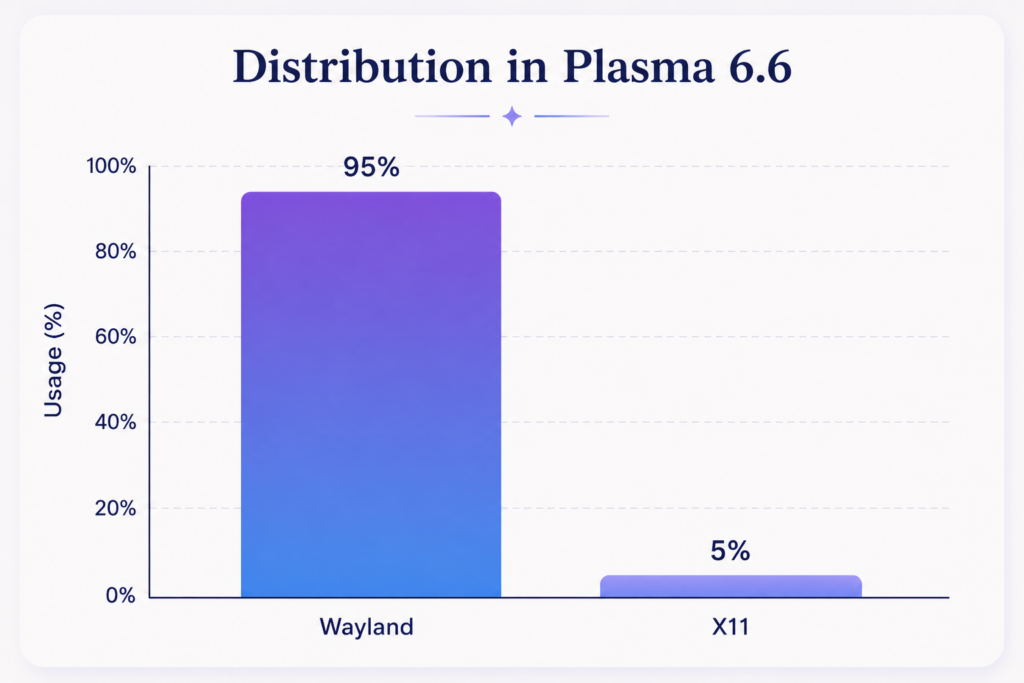
This reminds me of the systemd folks - they also don't allow for discussions yet alone cite anything related to their claims. They just claim. If the earth is flat, they don't need evidence. Their word must be enough.
It is this image:
http://blog.davidedmundson.co.uk/wp-content/uploads/2026/06/...
David claims "internal metrics", but he also does not explain how those metrics were gained, is there bias in how they were gained, which time span and so forth.
I am not saying he is fabricating the graph, though this could be the case too. What I am asking for is to show (ALL of) the data and explain the graph and data. Otherwise this is simple propaganda, with a pre-set goal to cover-my-ass (aka explain why KDE devs try to eradicate all xorg users).
By the way, next step, as you guys may know: systemd-only. Both David and Nate also announced this before. I wonder if there are financial kickbacks.
undefined 4 days ago |
shevy-java 4 days ago |
Oldschool KDE devs were better. Today's generation of David or Nate, are just killing KDE off. But no worries, on their blog they'll continue how everything is great. It is so great that they need a donation-widget to keep on pestering people to donate. So now you can pay for them ruining the legacy here.
calvinmorrison 4 days ago |
Good bye KDE. Good bye Red Hat. We're doin our own thang now.
jackyard86 1 day ago |
In software rendering, CPU only updates screen when changes are detected. And the change completes as fast as the computer can. So that's minimal latency + minimal resource consumed.
If you're on a compositor, the 3D accelerator in your computer has to update the screen 60 times every second. It's even worse when you have a higher refresh rate display. And compositors update the buffer as soon as the previous buffer is pushed after the v-sync signal, and then it just waits until the next signal comes in. So there comes the terrible input delay. As a result, it comsumes more power and has higher latency.
So in conclusion, fuck Wayland, and I'm going with xfce without compositor.
mvdtnz 4 days ago |
Yamboho 3 days ago |
ceayo 3 days ago |
Yamboho 3 days ago |
gjvc 4 days ago |
rid 4 days ago |
KRdp on Plasma/Wayland is still much more fragile. It depends on a logged-in Plasma session, has rough edges around unattended access, session startup, reconnection, display sizing, authentication/cert handling, and general automation. Those are exactly the things cloud desktops and disposable VM images need to be boringly reliable.
I’m not against deprecating X11 long term, but deprecating it before KRdp is a solid replacement leaves server/VM/remote-desktop users in a bad spot, hopefully now the team can focus solely on Wayland, KRdp will receive some much needed love.
startpage_com 4 days ago |
jccx70 4 days ago |
self_awareness 4 days ago |
notepad0x90 4 days ago |
LaGrange 3 days ago |
It describes the regression in accessibility software for Linux from x11 to Wayland. Unfortunately, judging by the pace of protocols being accepted, I think we're years out from having a solution.
The most notable thing not working is Talon, which is a voice input system that lets you insert speech to text, manipulate windows, call scripts, etc, all via voice. It's software that works on Windows, MacOS, and x11, but not Wayland.
I think unfortunately right now the best bet is to, if you need the software, stick with X11 for as long as possible. An environment like i3 will probably be maintained for decades to come. Alternatively it might make sense to build some type of bespoke solution on top of a specific wayland stack, like re implementing what you get of talon in a kde plugin or via sway IPC. This seems viable to me but an incredible amount of work.
For people that need this, having to be a developer and build your own tooling in order to use your computer... it's not a future of Linux I'm particularly excited about. I don't want to leave people who need accessibility software behind, and I don't think any security justifications are actually real roadblocks which would prevent being able to serve these people. We have a coordination problem. It's less of a technical issue and more of an issue of getting people to agree on protocols which would let software like Talon work against the entire ecosystem.
I am happy the ecosystem is moving to Wayland, I think we're going end up in a better place. Wayland does solve some real problems for me (x11 screen tearing / frame pacing issues on Nvidia). I'm happy that KDE exists, it's great software.