370 points by alihm 6 days ago | 384 comments | View on ycombinator
hardwaregeek 5 days ago |
boh 5 days ago |
dfgknionio 5 days ago |
https://substackcdn.com/image/fetch/$s_!5kYm!,f_auto,q_auto:...
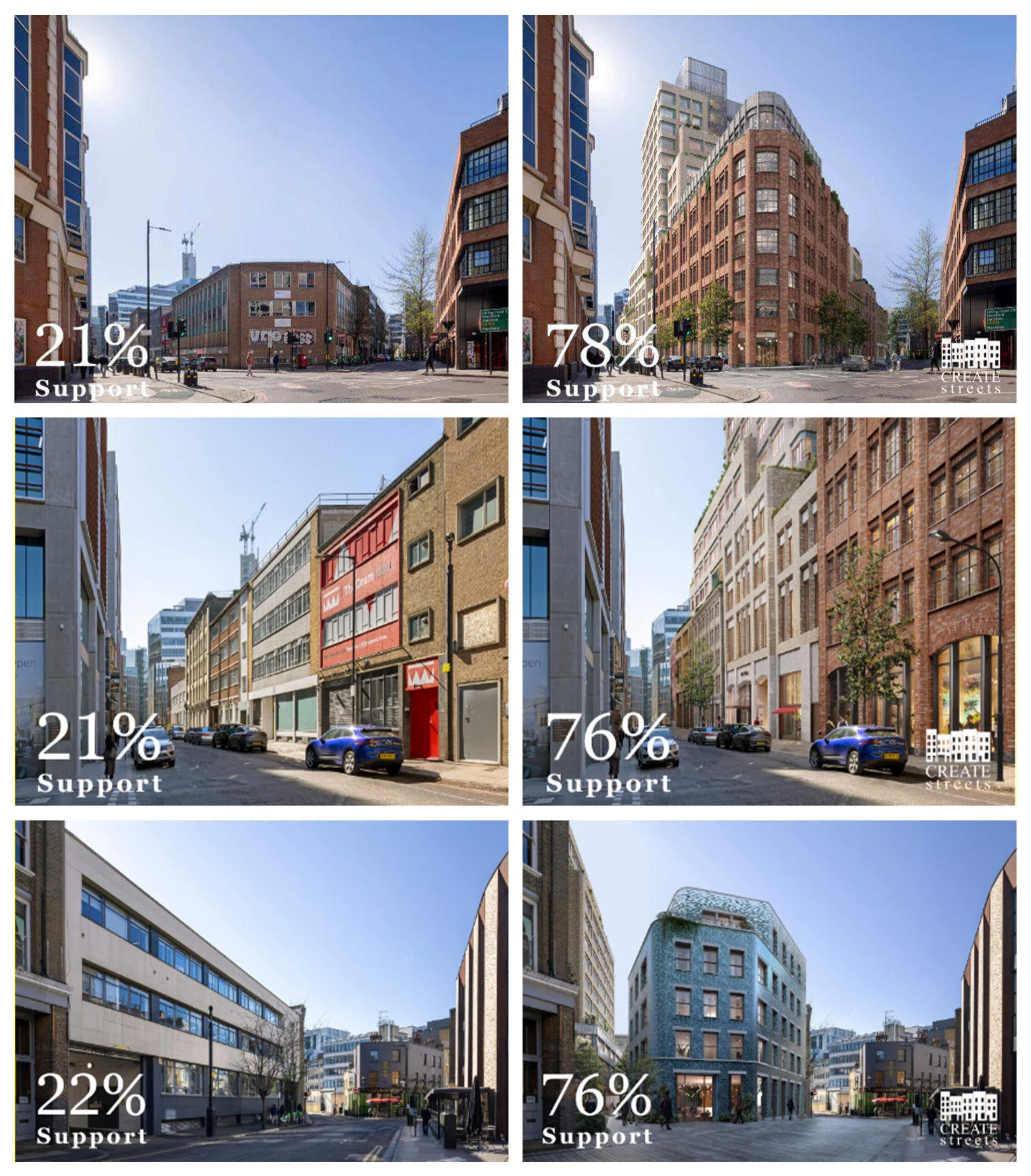
Which side is modern and which is traditional? The examples on the right are clearly more modern than the examples on the left to my eye: the left looks like it's from the '70s while the right is unmistakably 21st century. But the examples on the left are run-down, plain, and feature advertisements and bricked-up windows and steel shutters and security doors, while the examples on the right are brand new and shiny and walkable. There's graffiti in the first example and in the last one they replaced the asphalt with pavers!
Hard to take the conclusions seriously when the authors have their thumbs on the scale.
perilunar 5 days ago |
chasil 5 days ago |
“Yes, God damn it, the Parthenon!”
The ruler struck the glass over the picture.
“Look,” said Roark. “The famous flutings on the famous columns—what are they there for? To hide the joints in wood—when columns were made of wood, only these aren’t, they’re marble. The triglyphs, what are they? Wood. Wooden beams, the way they had to be laid when people began to build wooden shacks. Your Greeks took marble and they made copies of their wooden structures out of it, because others had done it that way. Then your masters of the Renaissance came along and made copies in plaster of copies in marble of copies in wood. Now here we are, making copies in steel and concrete of copies in plaster of copies in marble of copies in wood. Why?”
addaon 5 days ago |
tensor 5 days ago |
DGAP 5 days ago |
I'm more curious about residential though - see huge interesting in MCM over the last decades. I am biased but I think there is a great deal of interest in warm, modernist spaces with ideas like natural materials and lots of natural lighting, especially when compared to the beige boxes of American home building.
petsfed 5 days ago |
Cultures have visual languages just the same as they have written and spoken (and signed) languages. The crucifix symbol has an understood meaning in most European cultures, because of how foundational Christianity is to their cultures. Is it really so surprising that people prefer buildings in a visual language they already understand?
There's also this paragraph at the very end:
>If this is true, a greater puzzle comes into view. Almost every architectural school in the world exclusively teaches broadly modernist styles, and probably more than 99 percent of architects practice exclusively in them. In Britain, there has been hardly a single public commission in a traditional style since the 1950s, and only a trickle of commercial and institutional ones. Except in the market for private housing, traditional styles have been virtually extinct for seven decades. Although in some cases this can be explained by anti-traditional planning rules, the broad trend is still evident in jurisdictions whose development control systems are stylistically neutral.
In a world where we've seen nothing but modernist designs for 70 years, is it really that surprising that people might prefer novel designs? Especially novel designs in a style they are repeatedly told is better, or references a more refined time?
hahamaster 5 days ago |
I wish more people were building brand new, modern neoclassical buildings that are truly beautiful in a Haussmannian way, yet as practical as modern skyscrapers.. something like 1 Mayfair in London or 150 East 78th Street in New York.
Yizahi 2 days ago |
Oh, this is actually pretty obvious to explain. There are several equally big reasons, in no particular order here:
- Modernist/brutalist/bauhaus etc. building with any stated use type is on paper cheaper to build, because it removes all aesthetic features and many functional features - like rain pipes, slanted roof in favor of flat roof, human oriented features like benches etc. It will be much more expensive to maintain in long run, due to the environmental damage from missing functional features, but that's not architect's problem then.
- These buildings are build as a class warfare. Notice the stark difference between designs of private houses where higher class actually lives, and the designs which the are commissioning for the common public.
- Performative architecture. The weirder the art form, the better PR and resulting fame.
nairboon 5 days ago |
throwaway713 4 days ago |
m0llusk 4 days ago |
And then there is the issue of construction. Many older designs use materials and methods that are either out of date or expensive to replicate with currently popular building materials. Simply going back to older designs is not a practical option for most buildings. There has to be some balance of old ideas with newer methods.
jiehong 5 days ago |
Modern buildings often are their own idiosyncratic isolate in the middle of the city.
When looking at movies, cities tend to have a uniform feel and look (like the elvish Rivendell), and I think people enjoy that.
Like Mont-Saint-Michel in France, or the Chuxi Tulou village in Fujian, China.
Joker_vD 5 days ago |
Or maybe do nothing, it's not like the public opinion really matters in the technocratic settings.
strstr 4 days ago |
The funny one is the buildings that have better landscaping. A few of the buildings in the post only look attractive as a consequence of the green courtyard in front. If you cover up that part of the photo, they just don’t look as stunning compared to the other. Perhaps that’s an argument for traditional courtyards (fair enough), but it doesn’t imply the need for traditional building construction.
iamnothere 5 days ago |
ogogmad 5 days ago |
Then again, I wonder whether the modern innovation of using steel under tension could enable us to make the "wings" (buttresses) smaller.
dzonga 5 days ago |
& buildings shape lives.
the only way to reverse the modernist trend is to have laws that incentivize classical buildings otherwise we gonna keep getting ugly buildings.
lofaszvanitt 5 days ago |
lateatdesk 5 days ago |
nobodywillobsrv 5 days ago |
They are comparing "same buildings" with AI but I would imagine they are not controlling cost.
Imagine gargoyles and metal dragons on drainpipes and all the ornamentation now and how much that would cost.
People prefer ancient dry stone walls over fences but they cost orders of magnitude differently.
I wonder if with robots and what not if we will see a resurgence in detail and ornamentation and other kinds of expensive but nice constructions.
tancop 5 days ago |
Abstract modernism with random shapes and obsessively minimalist design is only the worst case scenario where all the hate is justified. It's what happens when architects design for each other and not the rest of us.
Tanoc 4 days ago |
People don't understand these individual parts and don't understand how they all work together. But they definitely feel the cumulative effects, and those cumulative effects are much friendlier than Modernist and post-Modernist design. Modernism and all the schools that followed it rely on electric technology to fill in the gaps in the design, which makes them feel less accomodating to humans. Electric lighting, electric heating and cooling, and electro-mechanical traversal. Those things aren't as tactile, and many aren't even visible. The Modernist building does not present itself as something humans made, maintain, and interact with, but instead presents itself as a machine that you are temporarily inside of as a foreign entity because everything designed to outwardly accomodate humans is instead either streamlined down or fully away. The overhead lights shine light that you cannot influence, the hidden vents expel air from a place you cannot see or change, and the hanging facade glass walls provide no palpable separation from the outside world. Your mind tells you that this mid-century tower is a place where you do not belong.
cassepipe 3 days ago |
sfeng 4 days ago |
akk0 4 days ago |
I feel similar positive about new buildings in my native Netherlands, which seem to be getting less flat and with smaller, more reasonably sized windows (if you know, you know!)
belviewreview 4 days ago |
tolerance 5 days ago |
fsqcds 4 days ago |
chris_armstrong 4 days ago |
That in itself could be traced back to the professionalization of building manufacturing - the small-scale building and design that happened before this industrialisation of construction did away with all the little vernacular architectural decisions that would have been part of a building's design. Far more of the labour-force was involved in building construction, and less was done with pre-fabricated materials (probably just bricks and mortar), and certainly not as much was done on a mass-scale with the same homogenous approach^2, and with much less concern for the labour costs associated with those little details that add "character" to an older building^3.
I'm starting to find small examples of lower-scale construction projects in my home city (Sydney) that seem to return some interesting elements to newer building construction, like variation in materials such as perforated shading or different colours or textures of prefab cladding, using brick for feature walls in other pre-fabricated concrete buildigs, more external hanging gardens, etc). This is better, and I'm happy to see it, because while the older federation terraces in Sydney are nice to look at, they're hopelessly underdesigned for the climate (too hot in summer, too cold in winter, too dark in a country that is blessed with natural light, and often with damp and mould problems that shouldn't exist on a building post 1900).
^1 popular in the sense that its widespread amongst the general population, not the way modernism is popular with architects, both for its cost and the way its become part of the popular taste of architects as a profession
^2 the treasured old neighbourhoods in cities that are preserved and made "heritage" are the results of hundreds of individual decisions by dozens of individual builders and tradespeople, which although similar, contain enough difference to convey a sense of character. Compare that with a small team of planners working for a single construction company remaking a block or entire suburb.
^3 I could be wrong, but I would have thought labour costs were a much lower component of building construction then, or at least there was far more labour hours that go into a building's construction, allowing more time for the little details that give an older building its little characteristics like lacing, fancy brickwork or unusual reliefs.
jongjong 4 days ago |
TomMasz 4 days ago |
expedition32 5 days ago |
Unfortunately my European brothers and sisters prefer to live in open air museums. However slowly but surely skyscrapers have been creeping up into the Netherlands- you just can't beat the efficiency.
protocolture 5 days ago |
But most people will prioritise cost (both capex and opex) and comfort over aesthetics.
lanfeust6 5 days ago |
Modernist builds aren't really cheaper.
collabs 5 days ago |
nitwit005 4 days ago |
lIl-IIIl 4 days ago |
slibhb 5 days ago |
I'm not a hater on modernism -- I like stripped down literature and architecture (though I wish concrete buildings were cleaned more regularly). But there does seem to be some truth in this idea that "the elite critics" have dominated these fields, resulting in the production of art (and buildings) that are broadly unpopular. I think the overriding goal of these critics is avoiding kitsch, which they see in classical forms.
enaaem 5 days ago |
prodmod 5 days ago |
rickcarlino 5 days ago |
kazinator 4 days ago |
quickthrowman 5 days ago |
contingencies 5 days ago |
Onavo 5 days ago |
shen 5 days ago |
bickfordb 4 days ago |
mcphage 5 days ago |
janpeuker 4 days ago |
The National Civic Art Society is designing the White House State Ballroom [1] and Create Streets is a conservative influence group that likes speaking at Reform UK events [2]. As many others here have pointed out, visual preference, especially in such a binary choice between obviously cheap and ugly vs expensive and generous, is of course highly biased - pseudo greek style doesn't fly in Asia, even in Australia minimalist styles are much more en vogue.
The most important claims like "exclusively teaches broadly modernist styles" are completely unsupported - especially when a few lines down they literally use their own review of an architect's design, but then call it "in a style drawing on Victorian commercial architecture and Art Deco", again unsubstantiated - it has pretty "modern" clear lines, probably due to sustainability [3], and brick facades themselves have been around for long. In the report they praise the 2010 (!) London city building design guide recommending exactly this brick design. "hardly a single public commission" and "we commissioning styles"?
Where is the line between justifying dictator-style grandiose architecture and the actual empathy needed for simply good design?
I'm just asking questions.
1) https://www.dezeen.com/2025/01/29/justin-shubow-trump-archit... 2) https://www.building.co.uk/focus/reform-uk-conference-fundin... 3) https://www.archpaper.com/2025/10/biennale-architettura-carl...
mikeaskew4 5 days ago |
FLeXMurphy 5 days ago |
The examples where arch students gave higher scores, like with that god awful-looking house, I don't have an answer to. Maybe they had terrible taste. Just because you are a student of architecture it does not mean you have good taste or how to build beautiful things that evoke a specific emotion.
beachy 5 days ago |
I might be missing something but isn't this all a bit of a no-brainer?
In the old days, buildings were made to impress, to project wealth, to show the generosity of wealthy benefactors to their town or city. Take a look around somewhere like historic Bruges, which benefited from the wealth of local merchants. Incredibly impressive. Not remotely cost effective.
Today, buildings are typically functional, or at least financial considerations are top of mind. And cheaper tends to be uglier. Why would someone invest in an elaborate and expensive design when they could simply throw up a slab of brutalist concrete and punch some windows into it? It's all the same to the workers inside.
And of course for older folks, older buildings are closer to what they grew up with. Even if only a bit. Seems a natural effect for older people to enjoy older architecture.
infakelife 5 days ago |
Maybe the average modernist building really is that bad and the issue is that "traditional" buildings are more forgiving for an average architect.
mr-pink 4 days ago |
bobowzki 5 days ago |
alex-moon 5 days ago |
Like what? A shadowy cabal of liberal elites pulling the strings from the shadows? Stripe (who own Works In Progress) founder Patrick Collision donated to the Trump campaign in 2024. Tiresomely obvious what this "piece" is trying to do. Find a new gimmick imho.
trgn 5 days ago |
as an aside, for the longest time i have thought modernity was fully understood by the 60s (ellul, debord, macluhan, ...). but maybe there the focus was too narrowly political, sociological. it has been revealing to see this ethos (and it is an ethos, make no mistake) recently linked to autism. high modernists are uniform, monomaniacal people. like machines. and the world they fashion, is therefore one that is uniform, principled. how the unsociable autist colleague cannot distinguish between is and ought, so will modern architecture barrel down deductively to its unpleasant conclusion.
modernisn is the commodification of all spheres of existence, it is an unprecedented evolution, how to break out of this, how to get of this train with only a single endpoint.
undefined 5 days ago |
VoodooJuJu 5 days ago |
aaron695 5 days ago |
zjp 5 days ago |
extrememacaroni 5 days ago |
andy_ppp 4 days ago |
Zigurd 5 days ago |
I know that personally I find New York’s prewar buildings more beautiful than your average soulless luxury tower. But I enjoyed living in a soulless luxury tower because it had good lighting, not terrible elevators and decent fixtures.